Things to Do in Theth
Theth Church (Kisha e Thethit)
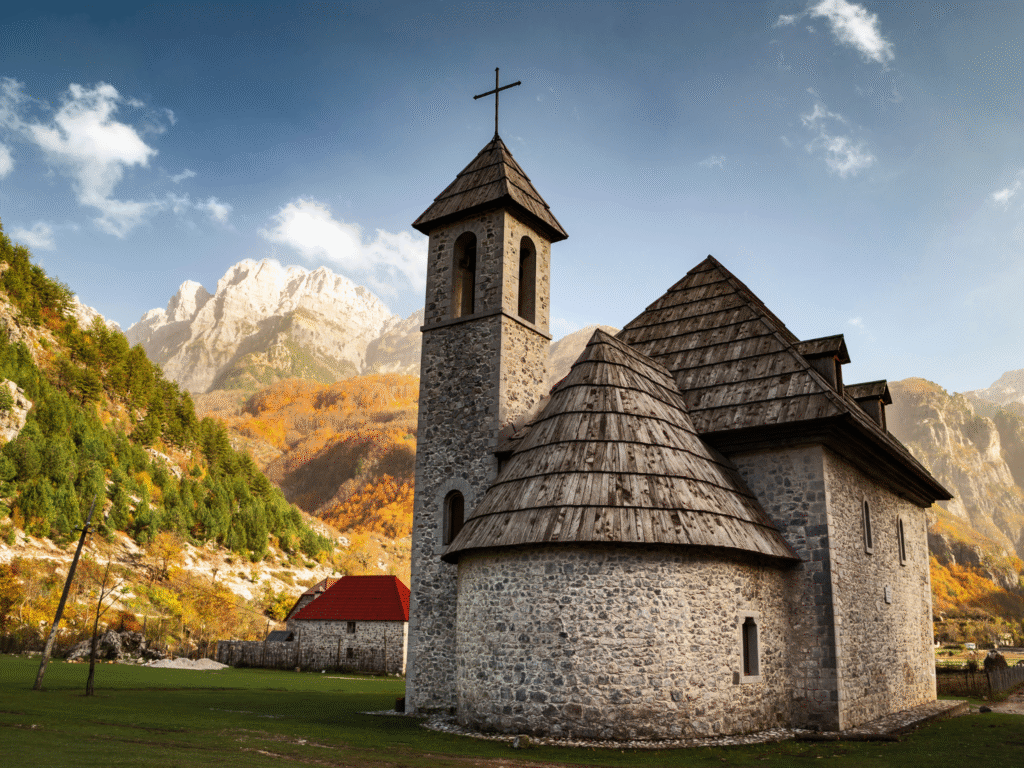
The church of Theth is the most photographed landmark in the Albanian Alps and the first thing most visitors seek out. Built in 1892, it is a simple stone and timber structure set in a meadow with a wooden fence and a backdrop of sheer limestone peaks that rises almost vertically behind it. This village has historically been Catholic, with many such Catholic villages existing in northern Albania due to the difficulty the Ottomans had in conquering the mountainous region. During the communist era, when religion was banned, the church was repurposed as a maternity clinic for the valley. It was reconstructed after 1990 on the original foundations and is still active during summer months.
The best time to visit is early morning or late afternoon when the peaks catch directional light. The view from the small path leading to the entrance is the classic framing. Entry is free and the church is usually open on Sunday mornings when a priest is present.
The Lock-in Tower (Kulla e Ngujimit)
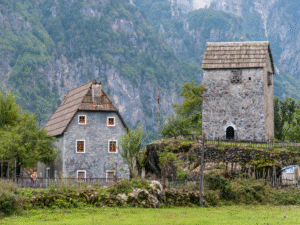
A five-minute walk from the church brings you to Theth’s Lock-in Tower, one of the most culturally significant landmarks in the Albanian Alps. Lock-in towers were used in Albania and the Balkans to imprison men who violated the Kanun Law, a set of traditional Albanian laws. The perpetrator’s imprisonment would only end when either a member of his family was killed or when the families affected by his crime would grant him forgiveness. The tower today functions as a small museum with a modest entry fee of around 150 Lek. Opening hours can be sporadic; ask at your guesthouse the evening before if you want to be sure of access.
The Kanun of Leke Dukagjini, the ancient highland code that governed life in these villages from the 15th century, is one of the most fascinating threads running through northern Albanian culture. The Kanun covered everything from land rights and hospitality obligations to the blood feud system (gjakmarrja) that the Lock-in Tower was built to manage. Understanding it adds enormous depth to what is otherwise just a stone tower in a field.
The Drive from Shkodër to Theth
The 75 km road from Shkodër to Theth is worth treating as an attraction in its own right rather than just a means of getting there. The journey winds through valleys, rivers, and pine-covered slopes, offering some of the most breathtaking views in Albania. The final stretch from Boga to Theth has been largely improved, though a 4×4 is still recommended. Along the way, small roadside stalls sell honey, herbs, and homemade jams. The views become spectacular about halfway through as the road begins climbing toward the high mountain terrain above the tree line.
Visit Theth with Everything Arranged
Private transfers, expert local guides, hand-picked guesthouses. No logistics stress.
Day Hikes from Theth
Grunas Waterfall and Theth Canyon
Distance: ~10 km loop | Elevation gain: ~600 m | Duration: 5 to 6 hours | Difficulty: Moderate
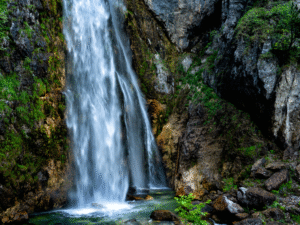
The Grunas Waterfall drops 25 to 30 metres over a limestone rock face and is designated an official Albanian Natural Monument. The loop trail from Theth passes through Theth Canyon, crossing wooden footbridges over the river with the canyon walls rising steeply on both sides. Wildflower meadows make this especially rewarding in June and early July. The trail is straightforward and well-used, suitable for any reasonably fit walker. Start early to have the canyon to yourself before other hikers set out.
Blue Eye of Theth (Syri i Kalter)
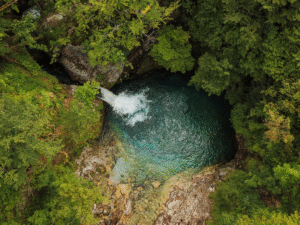
Distance: ~10 km return from village (or ~4 to 5 km return from Nderlysa) | Elevation gain: ~400 m | Duration: 4 to 5 hours | Difficulty: Moderate
The Blue Eye is a natural spring producing water of an almost impossible turquoise, sitting in a limestone gorge surrounded by dense forest. The pool stays at around 8 to 12 degrees Celsius year-round. Note that there are two Blue Eyes in Albania: one near Theth in the north and one near Saranda in the south. The two should not be confused. The one in Theth is wilder and less visited. To cut the walking distance, arrange a transfer from Theth to the hamlet of Nderlysa through your guesthouse the evening before. Go early: it can be busy from around 10 am in peak season.
Valbona to Theth Crossing
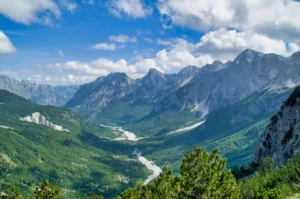
Distance: 14 km one way | Elevation gain: ~1,000 m | Duration: 7 to 9 hours | Difficulty: Moderate to Strenuous
The most famous hike in the Albanian Alps connects Theth and Valbona over the Valbona Pass at 1,795 m. It is one of the finest day hikes in the Balkans and the reason most hikers visit Theth in the first place. Full details, logistics, and tips are in our dedicated hiking guide to northern Albania. This crossing features as Day 4 of our Hike the Albanian Alps signature tour.
How to Get to Theth
All routes to Theth pass through Shkodër, which is the main gateway city for the Albanian Alps.
By shared furgon from Shkodër: Shared minivans depart from Shkodër most mornings in summer, typically between 7 and 9 am. The journey takes around 2.5 hours on mountain roads. Book through your accommodation in Shkodër the evening before to confirm seat availability. Cost is around 10 EUR per person each way.
By private transfer: Faster, more comfortable, and allows stops for photos along the way. All RakiYa tours use private transfers throughout. If you are travelling independently, transfers can be arranged through guesthouses in Shkodër or Theth.
By rental car: The entire road from Shkodër to Theth is now tarmacked, meaning it is possible for most competent drivers in a standard car. There are several car hire options in Shkodër and plenty in Tirana. A 4×4 is still recommended for the final stretch and essential if you visit outside peak season when road conditions are less predictable.
From Tirana: Shkodër is around 2 hours north of Tirana by bus or private transfer. Tirana buses for Shkodër depart regularly from the north bus station throughout the day.
Where to Stay in Theth
Accommodation in Theth is almost entirely family-run guesthouses (bujtina). Rooms are simple, clean, and typically include dinner and breakfast in the price. This is a genuinely important point: the food at Theth guesthouses is outstanding by any standard. Fresh bread, homemade cheeses, garden vegetables, locally sourced meat, and homemade jams served at a communal table with the family is a highlight of the visit in its own right.
Rates run from around 20 to 40 EUR per person per night including half board. Book well in advance for July and August. Cash only in almost all cases. One practical note: be certain of the location of your accommodation before booking, particularly if you do not have your own vehicle. Theth is a scattered valley and some guesthouses are a significant walk from the church and main trail heads. Aim to stay in the southern part of the village, closest to the church, the Lock-in Tower, and the start of the main hiking trails.
Food and Drink in Theth
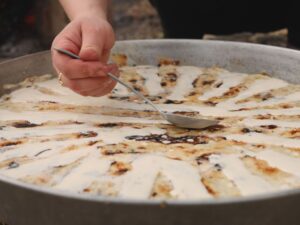
Eat at your guesthouse. This is the honest advice, not a platitude. The food at Theth guesthouses is a genuine highlight of the visit, and the dish you will encounter above all others is fli (also spelled flia or flija). Fli is a baked product consisting of multiple crepe-like layers brushed with cream, belonging to Albanian and Kosovar gastronomy. The watery dough made of flour, water, and salt is cooked on a baking tin placed under a traditional oven called a saç, a bell-shaped iron dome covered with burning coal, which allows the heat to permeate and cook the layers evenly. The process takes hours to complete, but the end result is well worth the wait.
The secret to a real fli is kaymak, a fermented cow milk cream renowned across the western Balkans and increasingly difficult to find. The best kaymak comes from mountainous areas, which is exactly why Theth is one of the best places in the world to eat fli as it should taste. It is typically served with honey, yoghurt, local cheese, and homemade jam. If your guesthouse is making fli the morning you arrive, count yourself lucky.
Beyond fli, guesthouse dinners typically include dishes like Tavë Kosi (lamb and rice baked in yoghurt), fresh-baked bread, local cheeses, seasonal vegetables from the garden, and slow-cooked meat stews. After a full day on the trail, these are exactly the meals you want. Outside the guesthouses, a small number of mountain cafes operate on the main trails in peak season, and a single small shop near the church sells water and basic provisions. Do not rely on either for anything specific. Stock up in Shkodër before heading up.
Best Time to Visit Theth
June: Wildflowers carpet the valley floor, the peaks still carry snow on their upper slopes, and the trails are quiet. The road is fully open and guesthouses are operating. The best month for those who want Theth at its most vivid and peaceful.
July and August: Peak season. All guesthouses and trail cafes open, reliable sunshine, warm daytime temperatures. The village is noticeably busier with both Albanian families and international hikers. Book accommodation at least 4 to 6 weeks ahead.
September: The finest month overall. Crowds drop sharply after the first week, temperatures are comfortable at 15 to 22 degrees Celsius, the beech forests begin turning gold, and the quality of light in the valley is exceptional. The hiking trails are at their best and guesthouses are still fully operational.
October: Autumn colour peaks in early October. Trails are quiet and the scenery is extraordinary. The road may become difficult after heavy rain in the second half of the month and some guesthouses begin closing. A 4×4 is recommended.
For full seasonal advice across Albania, see the RakiYa When to Travel guide.
Practical Tips for Visiting Theth
Cash: There are no ATMs in Theth or anywhere on the road from Shkodër. Bring enough Albanian Lek or Euros for your entire stay. Guesthouses, trail cafes, the Lock-in Tower entrance fee, and the Nderlysa minibus all require cash.
Mobile signal: Very limited in the valley. Some guesthouses have wifi, though reliability varies. Download offline maps on Maps.me before you lose signal on the drive up. Trail markings are good but a map is essential backup.
Footwear: Hiking boots with ankle support for the main trails. The Valbona to Theth crossing and the canyon trail both involve rocky, uneven terrain. Trail runners are adequate for the Blue Eye but not the full Valbona crossing.
Water: The mountain springs in and around Theth are safe to drink from. Carry a refillable bottle and fill it freely on the trails.
Electricity: Guesthouses have electricity but power cuts happen. Charge devices every evening and bring a portable battery bank.
How many days: Two nights is the minimum to do Theth properly: one day for the Grunas Waterfall and Blue Eye, one day for the Valbona crossing or Peja Pass. Three nights is comfortable and allows for a slower pace with time to simply sit in the valley and absorb the surroundings.
Frequently Asked Questions
Is Theth worth visiting?
Yes, without qualification. Theth is the most spectacular mountain village in Albania and one of the finest alpine destinations in Europe. The combination of scenery, hiking, cultural depth, food, and value for money is genuinely hard to match anywhere.
How far is Theth from Tirana?
Approximately 150 km by road, taking around 4 to 4.5 hours. The route goes via Shkodër (2 hours from Tirana) and then a further 2 to 2.5 hours on mountain roads into the valley. All RakiYa tours include private transfers from Tirana International Airport.
Can I visit Theth as a day trip from Shkodër?
Technically yes, but it is not recommended. The drive each way is around 2.5 hours, leaving very little time in the valley. You also miss the experience of staying overnight, which is one of the best parts of visiting Theth. Two nights minimum gives you a proper experience.
Is Theth safe?
Very safe. Albania has a low crime rate and the mountain communities are among the most welcoming in the Balkans. The main practical considerations are the mountain environment itself: weather changes, trail navigation, and the absence of mobile signal. Read our full guide: Is Albania Safe for Travellers?
Do I need a guide to hike in Theth?
The Grunas Waterfall and Blue Eye trails are manageable independently with a downloaded offline map. The Valbona to Theth crossing can also be done independently as it is well-marked. For less-travelled routes like the Peja Pass, a local guide is strongly recommended. Our local expert guides provide cultural context that transforms the experience beyond just navigation.
Ready to Visit Theth?
RakiYa Travel organises group tours and private trips to the Albanian Alps with expert local guides, private transfers, and hand-picked guesthouses throughout.